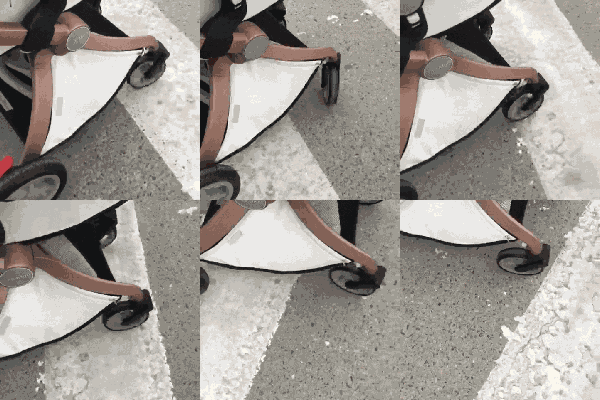
Wobbling (Oscillation) of Stroller Front Wheels: Causes and Solutions
(the presence of front wheel vibration significantly complicates stroller handling)
Quick analogy: Think of wobbling as the «shimmy dance» of the wheels — like when a shopping cart wheel suddenly starts shaking uncontrollably. Engineers call this the shimmy effect. It happens when tiny bumps in the road make the wheel vibrate, and if the speed is just right, these vibrations build up instead of dying out. You’ve probably seen it on motorcycles or even airplane landing gear!
Wobbling — an uncontrolled lateral oscillation of the front wheels of a stroller — is a common issue that significantly reduces ride comfort and control. The phenomenon intensifies with speed: the faster the stroller moves, the more pronounced the vibration becomes.
Parameter
Description
Wobbling frequency
Typically 2–5 Hz at speeds above 3 km/h (1.9 mph)
Amplitude
Up to 10–15 cm (4–6 in) lateral displacement
Trigger speed
Usually starts at 4–6 km/h (2.5–3.7 mph) on uneven surfaces
Surface sensitivity
Most pronounced on cobblestone, tiles, and loose gravel
Technical Causes of Wobbling
From an engineering perspective, the front wheel assembly acts as a mechanical oscillatory system with its own resonant frequency. Key factors contributing to wobbling include:
Low damping in the wheel suspension system
Improper wheel alignment (toe‑in/toe‑out angles)
Excessive play in the swivel mechanism
Insufficient wheel weight distribution
Resonance effects on periodic surfaces (e.g., tiles with regular spacing)
Manufacturer’s Position vs. User Experience
Many manufacturers do not classify wobbling as a defect, citing that the stroller remains functional. Common responses include:
Manufacturer’s Argument
User’s Counterpoint
«Not a defect — the stroller works»
Reduced control and increased physical effort for the user
«Use the straight‑mode lock»
Eliminates the benefit of swivel wheels (maneuverability)
«Normal for this design»
Compromises safety on uneven terrain
(front wheel lock for straight movement)
Prevention and Mitigation Strategies
To avoid or reduce wobbling, consider the following technical and practical solutions:
Solution
Implementation
Effectiveness
Wheel alignment adjustment
Set toe‑in angle to 1–2°
High — reduces oscillation initiation
Damping enhancement
Add rubber dampers or hydraulic dampers
Very high — absorbs vibrations
Weight redistribution
Adjust load distribution or add ballast
Moderate — stabilizes the system
Tire pressure optimization
Maintain 0.8–1.2 bar (11.6–17.4 psi) for pneumatic tires
High — improves shock absorption
Regular maintenance
Lubricate and tighten swivel joints
Essential — prevents play development
Diagnostic Methods
To identify wobbling at the purchase stage or during use, apply these diagnostic techniques:
Method
Procedure
Equipment Needed
Visual inspection
Check wheel alignment and suspension play
None
Test run
Push stroller at 4–6 km/h (2.5–3.7 mph) on different surfaces
Stopwatch, test track
Play measurement
Measure lateral and rotational play in swivel mechanism (should be < 3 mm or 0.12 in)
Feeler gauge
Vibration analysis
Use smartphone app to measure oscillation frequency
Smartphone with accelerometer
Technical Specifications of Problematic vs. Stable Designs
Comparison of key parameters that influence wobbling tendency:
Parameter
Problematic Design
Stable Design
Swivel radius
> 15 cm (> 5.9 in)
8–12 cm (3.1–4.7 in)
Suspension travel
Minimal or none
2–4 cm (0.8–1.6 in)
Wheel diameter
< 15 cm (< 5.9 in)
≥ 18 cm (≥ 7.1 in)
Damping system
Absent
Rubber/hydraulic dampers
Weight distribution
Front‑heavy
Balanced (60 % rear / 40 % front)
Professional Solutions for Existing Strollers
If you already own a stroller with wobbling issues, consider these professional modifications:
Swivel mechanism upgrade: Replace standard bearings with sealed ball bearings
Damping installation: Add rubber vibration dampers at pivot points
Alignment correction: Adjust toe‑in angle to 1.5° ± 0.5°
Weight redistribution: Install removable ballast in rear frame
Wheel replacement: Upgrade to larger diameter wheels with pneumatic tires
Case Study: Fixing Stroller Wobbling with Damping Washers
Real‑world repair example showing how homemade damping washers eliminated front wheel wobbling.
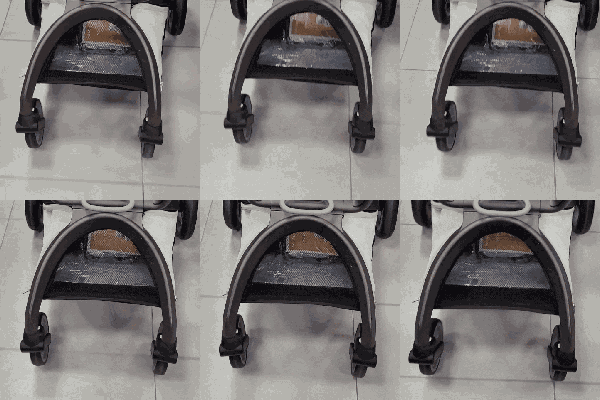
Before Repair
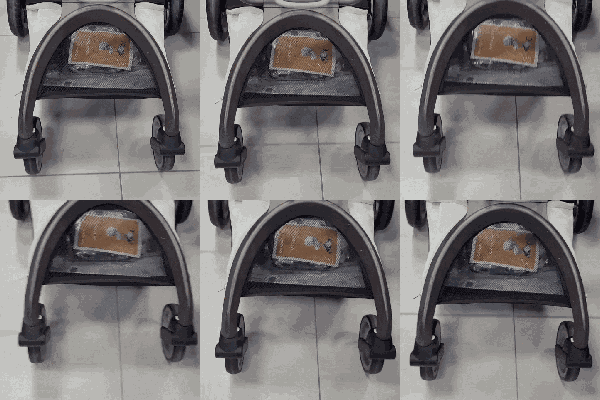
After Repair
Problem: Front wheels exhibit severe lateral oscillation at speeds above 2 km/h. Wobbling amplitude reaches 5–10 cm, making the stroller difficult to control.
Violent shaking visible even at low speeds
Vibration transmitted to handle
Reduced maneuverability
Solution: Installed custom‑made rubber damping washers at the swivel joint. This increased system damping and absorbed vibrations.
Wobbling completely eliminated
Smooth rolling at all speeds
Improved stability and control
Key Takeaway: Even simple DIY damping solutions can effectively address wobbling by increasing system damping. The fix cost under $10 and took 30 minutes to install.
Recommendations for Stroller Selection
When purchasing a new stroller, prioritize models with these features:
Front wheel diameter ≥ 18 cm (≥ 7.1 in)
Integrated damping system in swivel mechanism
Adjustable suspension travel 2–4 cm (0.8–1.6 in)
Swivel radius 8–12 cm (3.1–4.7 in)
Balanced weight distribution (60/40 rear/front)
Sealed bearings in wheel axles
Pneumatic or gel‑filled tires for shock absorption
Practical Tip: Always test a stroller in the store by pushing it at different speeds on various surfaces. Pay attention to:
Smoothness of swivel motion
Presence of play in the front wheel assembly
Ease of straight‑line tracking
Stability at speeds above 4 km/h (2.5 mph)
Fixing Stroller Front Wheel Wobbling (video):
Conclusion
Wobbling of stroller front wheels is a technical issue rooted in mechanical resonance and poor system damping. While manufacturers may not classify it as a defect, it significantly impacts usability and safety. By understanding the technical causes and applying proper selection and maintenance practices, parents can ensure comfortable and safe stroller operation.
Disclaimer: The information provided is for general guidance only. Modifications to stroller components should be performed by qualified technicians to maintain safety standards. Always follow manufacturer guidelines for maintenance and use.
Key Takeaways
Wobbling is caused by mechanical resonance in the front wheel assembly
It intensifies at speeds above 4 km/h (2.5 mph) and on uneven surfaces
Manufacturers often don’t consider it a defect due to functional operation
Pre‑purchase testing in physical stores is the most reliable prevention method
Professional modifications can effectively eliminate wobbling in existing strollers
Look for models with integrated damping systems and proper weight distribution
For further technical details or professional assistance with stroller modifications, contact certified stroller service centers. Regular maintenance and proper usage will significantly extend the lifespan and performance of your stroller.