When to Switch from Infant Car Seat? Engineer’s Safety Guide 2026
When to Switch from Infant Car Seat? Height, Weight & Safety Limits
Expert Audit: Moving from Rear-Facing Carrier to Convertible Seat
Quick Reference: Transition Parameters
Primary Standard
ECE R129 (i-Size) — Height-based priority
Typical Height Limit
40 cm to 75/83 cm (Model specific)
Max Weight Limit
Up to 13 kg (Group 0+)
Key Physics Factor
Vertex position vs. Shell edge
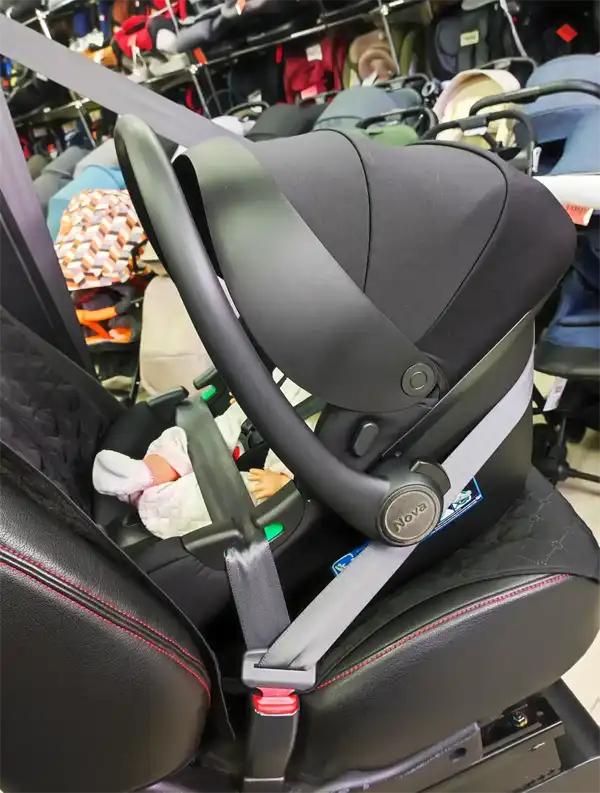
Biomechanical Load Distribution. This test bench setup demonstrates the ideal 45-degree angle. The infant's back and head are fully supported by the energy-absorbing shell, minimizing cervical spine tension during deceleration
The "Cramped Legs" Myth vs. Engineering Reality
Common Mom Concern
"Where do the legs go? They look squished!"
Biological Fact
Toddlers are flexible; cartilage is not bone. "Criss-cross applesauce" is natural and comfortable for them.
Safety Physics
Legs touching the vehicle seat is NOT a safety risk. In a crash, legs "cannonball" inward, protecting the spine.
Legs vs. Neck
Lower limb injuries are treatable; spinal cord integrity is critical. Rear-facing maximizes protection for the most vulnerable areas.
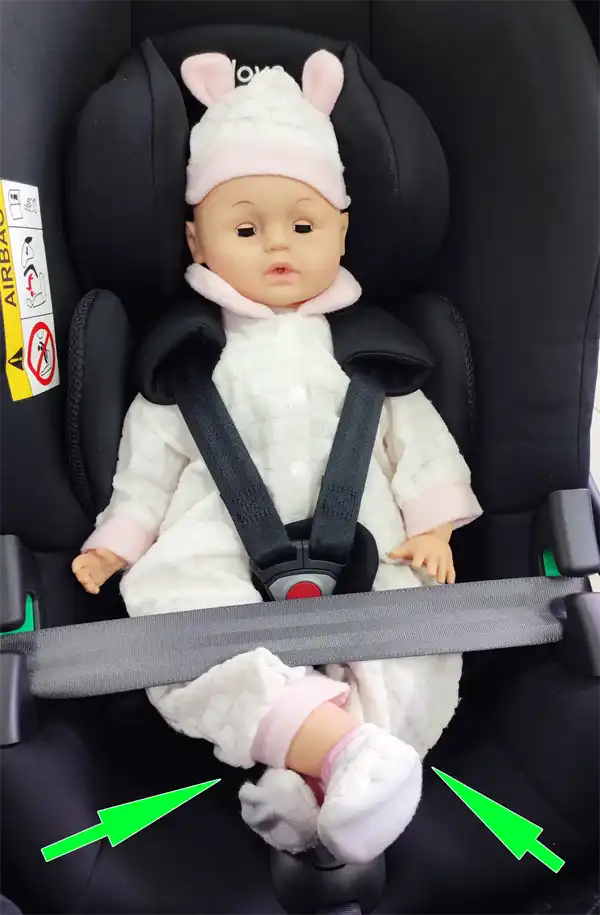
The "Cramped Legs" Myth. As demonstrated on the test bench, the "criss-cross applesauce" position is perfectly natural for a child’s flexible joints. From an engineering standpoint, having legs touch the vehicle seat is a minor comfort trade-off for 100% spinal protection
The Physics of the "Outgrown" Seat
Don't wait for the weight limit. Physics dictates that the head position is your primary safety indicator.
Visual Check
Engineering Requirement
Status
Top of Head (Vertex)
Must be at least 1 inch (2.5 cm) below the top of the hard plastic shell.
SAFE
Harness Position
Straps must be at or below the child's shoulders for rear-facing.
CRITICAL
Weight/Height Limit
Whichever limit is reached first (check the orange sticker).
OUTGROWN
The "1-Inch Rule" Audit. This is the most critical safety boundary. Using a measuring tape, we verify the distance between the child's head (vertex) and the top of the shell. If this gap is less than 1 inch (2.5 cm), the seat is outgrown, regardless of the child's weight
Rear-Facing vs. Forward-Facing: The Physics of Survival
Factor
Rear-Facing (The Shield)
Forward-Facing (The Whip)
Force Distribution
Spreads impact across the entire car seat shell and the child's back.
Concentrates force on the harness straps and the fragile neck.
Head Excursion
Head is cradled; movement is minimal.
Extreme: The heavy head snaps forward, risking internal decapitation.
Internal Deceleration
Gradual slowing down within the seat's padding.
Violent: Internal organs continue moving until they hit the chest wall.
American Academy of Pediatrics (AAP)
Highly Recommended until age 2+ or limit reached.
Permitted only after reaching limits (usually 22-40 lbs).
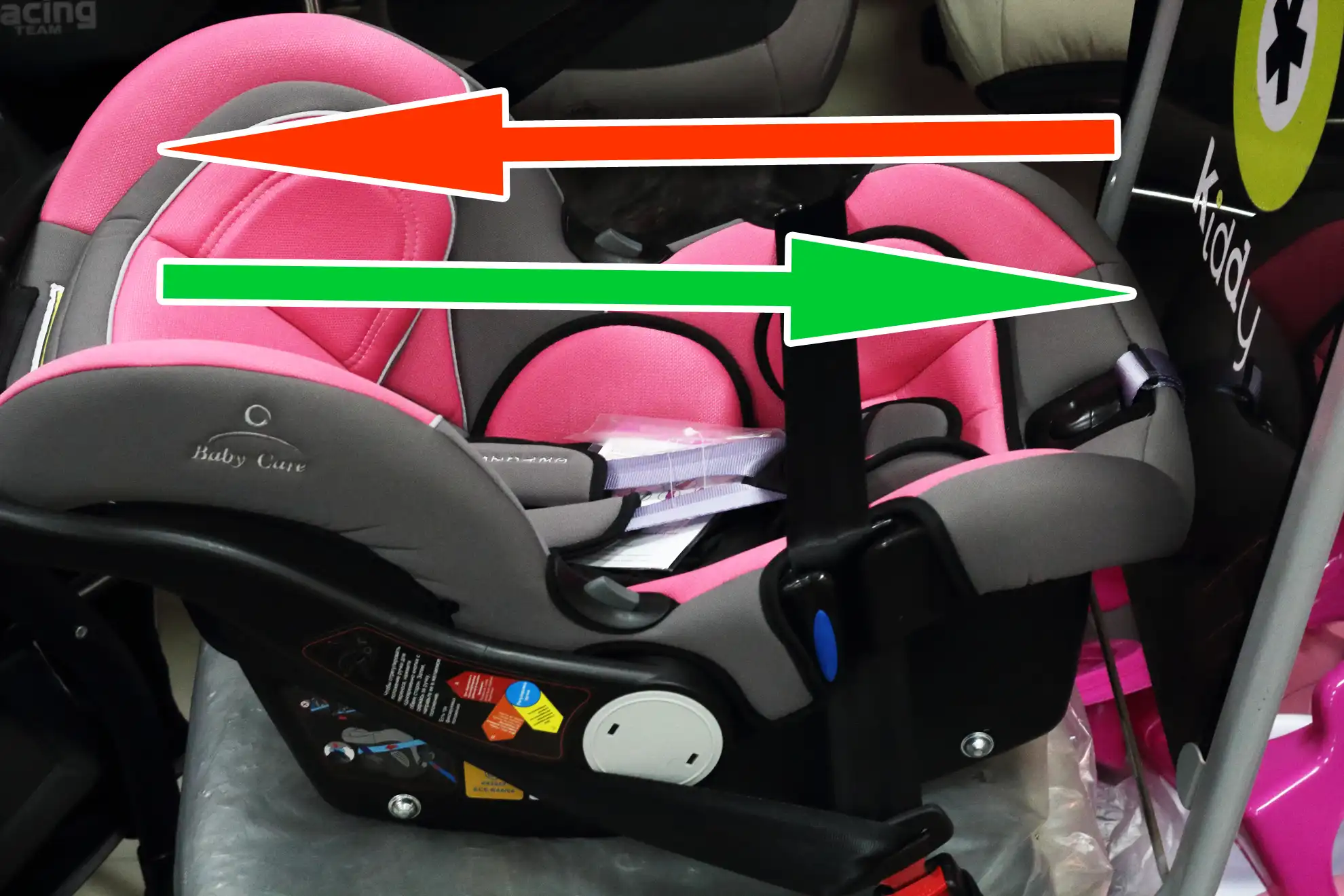
Rear-facing Engineering Setup. The arrow indicates the direction of impact force distribution. In this position, the car seat shell acts as a protective shield, cradling the head and spine
Why Adult Physics Don't Apply to Infants
An infant is not a small adult. Their skeletal structure and mass distribution require a completely different engineering approach.
Anatomical & Engineering Audit
Head-to-Body Mass Ratio
A baby's head is 25% of their total body weight. In a forward-facing snap, the weak neck ligaments cannot support this "cannonball" effect.
Skeletal Maturity
Neck vertebrae are still cartilage, not solid bone. Forward-facing tension can lead to spinal cord stretch (irreversible injury).
Contact Surface Area (Rear)
Maximum. Impact forces are spread across the entire backrest. Low pressure per square inch (PSI) on the body.
Contact Surface Area (Forward)
Minimum. Force is concentrated only on the harness straps. Massive pressure spikes on the shoulders and pelvis.
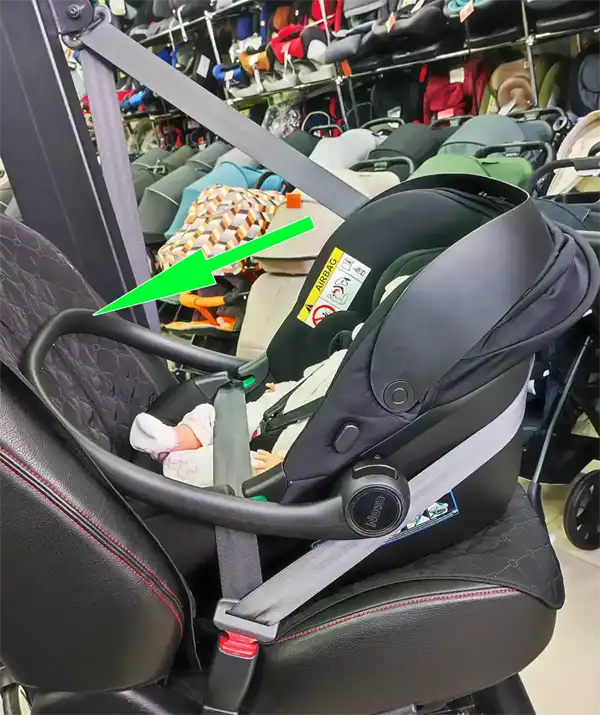
Handle as an Anti-Rebound Device. On this specific model, the carry handle must be rotated towards the vehicle seat back. This engineering solution prevents the seat from flipping (rebounding) towards the rear window during a secondary collision impact
The Engineer's Verdict: "Why wasn’t I told this at the other store?"
"I’ve heard this for decades: 'Why did they (at the big-box retailers or malls) tell us something completely different?'"
The answer is simple: I am an Engineering Specialist first, and a seller second. While others focus on sales quotas and hollow marketing, I focus on Pure Physics. My goal is to ensure your child survives a crash, not just to sell you another box.
Don't trust retail hype: The rear-facing position is a non-negotiable Safety Shield.
Your child's Spinal Cord is fragile; leg room is a secondary comfort issue.
Stop listening to "sales talk" — start looking at the Engineering Audit.
Physics doesn't lie.
Gennady — Engineering Audit & Global Safety Expert
Safety Audit: Frequently Asked Questions
1. When is a baby too big for an infant car seat?
A child has outgrown the seat when they reach the maximum weight/height limit shown on the orange label, or when the top of their head is within 1 inch (2.5 cm) of the top edge of the seat shell. Physics dictates that head clearance is the primary safety indicator.
2. What is the "1-inch rule"?
It is an engineering safety buffer. There must be at least one inch of hard plastic shell above the child’s head (vertex). This ensures that during the violent upward movement of a collision, the head remains protected within the safety "cradle."
3. Are cramped legs a safety risk?
Children are naturally flexible. From an engineering standpoint: spinal cord protection is the absolute priority, as skeletal recovery for legs is much more straightforward. Rear-facing ensures the highest safety level.
4. Why should I delay switching to forward-facing?
It’s about mass distribution. An infant's head makes up 25% of their body weight. Only a rear-facing seat can distribute the massive impact forces across the entire backrest, shielding the fragile neck from the "cannonball" effect.
Have a specific model you want to audit?
Contact the Engineering Expertise Center for a professional safety check.
Engineering Heritage: This audit is part of a long-term safety project. You can access my historical research and the original Russian version of this study (published in 2024) here: Original Russian Audit (vunderkindplus.ru)
Disclaimer: This article is not an official safety manual or a substitute for your car seat manufacturer’s instructions. It represents my personal engineering research, professional observations, and 43 years of technical experience. Always refer to your specific car seat manual and local traffic laws.